E-invoices as ZUGFeRD and XRechnung
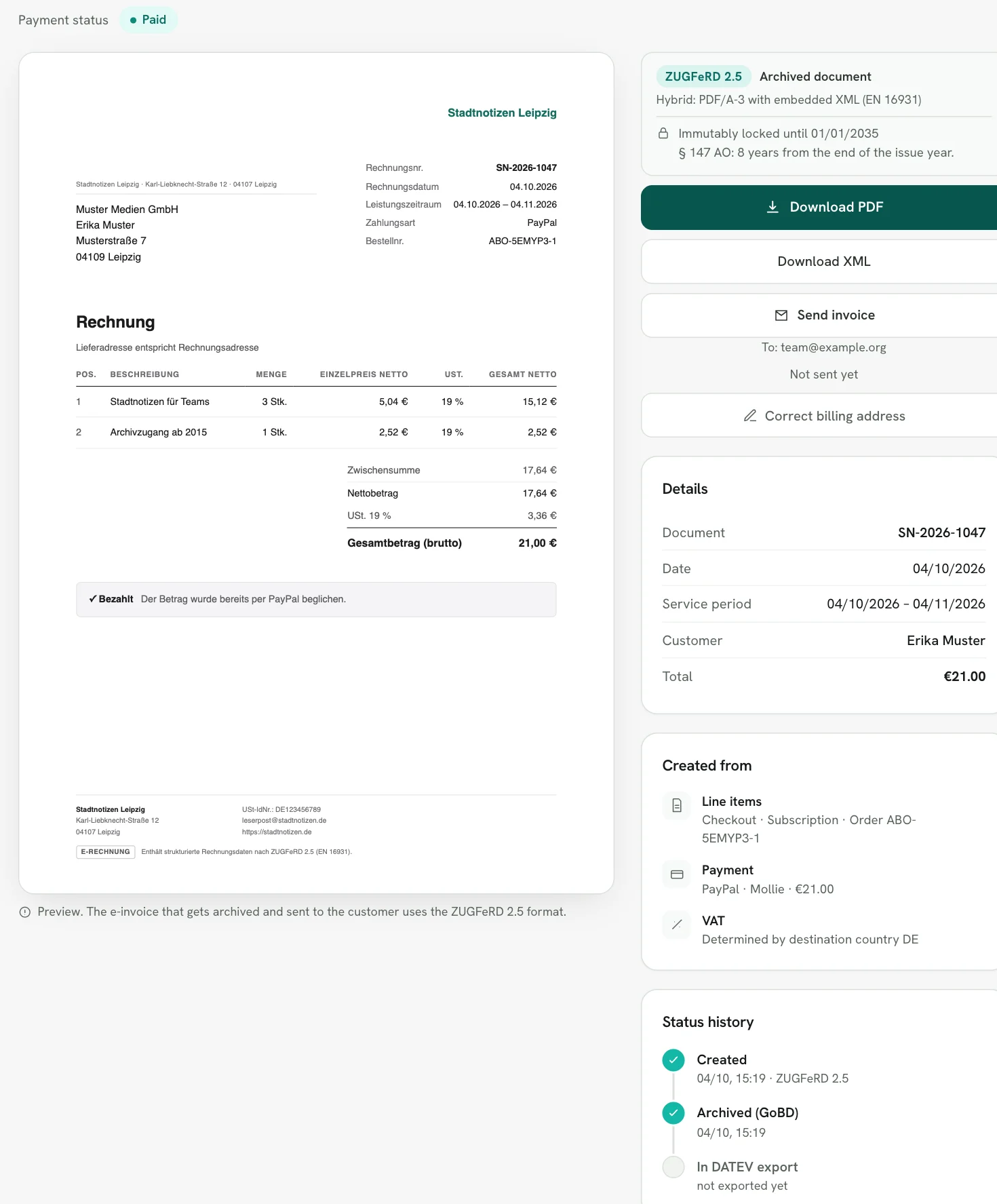
Rechnungskit issues every document as a ZUGFeRD invoice: a PDF/A-3 with embedded XML under EN 16931, valid for B2C and B2B. For public-sector customers an XRechnung 3.0 is created automatically as soon as a Leitweg-ID (the German routing ID for public buyers) is stored for the customer. If mandatory information is missing, the document is held back instead of being created wrong.
Why it matters
A plain PDF invoice is not an e-invoice (§ 14 para. 1 UStG, the German VAT Act). Since 2025 businesses in Germany must be able to receive e-invoices, and the obligation to issue them in B2B follows in stages until 2028 (§ 27 para. 38 UStG). Federal authorities generally require the XRechnung and address invoices through the Leitweg-ID (ERechV). If you handle formats, mandatory details and special cases such as the small-amount invoice by hand, you risk invoices the recipient rejects or that do not hold up for VAT purposes.
Which customer gets which format?
The default is ZUGFeRD in the EN 16931 profile, for consumers and businesses in Germany and the EU alike. The tax authorities accept ZUGFeRD from version 2.0.1 as an e-invoice, except the MINIMUM and BASIC-WL profiles (BMF circular of October 15, 2025, section 14.1 para. 14 UStAE). You do not need to set anything up: every order and payment produces this document automatically.
Public-sector buyers get the XRechnung. There is no project setting for it; the decision is made per customer. The Leitweg-ID gets into the system in one of three ways:
- You enter it under Customers in the "Invoice format" box.
- The buyer adds it in the Rechnungskit checkout or subscription checkout through the optional field for public authorities.
- Your system sends it via the API as
leitweg_idin the billing address.
An invalid Leitweg-ID is rejected. Subscriptions of a public authority create an XRechnung on every charge.
What happens when details are missing?
Rechnungskit does not create a document that fails the check. If your phone number as the seller is missing, it holds the XRechnung back and shows you a task. If the buyer's address is missing, Rechnungskit first checks whether a small-amount invoice is allowed. If it is not, you send the buyer a link where they add their billing address without logging in. As soon as the data is there, the document is created.
How is the e-invoice stored?
What gets archived is the structured XML data set, for eight years (§ 14b Abs. 1 UStG), in immutable storage with a SHA-256 checksum. The PDF view is reproduced from this XML. Invoices never change once created; corrections go through a cancellation invoice (Storno) or a corrected invoice. How the format is built is explained in ZUGFeRD explained, and the difference to the XRechnung in XRechnung explained.
In detail
- One document for people and machines: PDF/A-3 with embedded XML, ZUGFeRD in the EN 16931 profile
- Before it is created, every invoice is validated against the mandatory details of § 14 UStG and the format
- XRechnung 3.0 is triggered per customer: store the Leitweg-ID under Customers, ask for it in the checkout or send it via the API; all other customers stay on ZUGFeRD
- If a mandatory detail such as the seller phone number (BR-DE-6) is missing, the XRechnung is held back instead of being created wrong
- Small-amount invoices up to 250 euros under § 33 UStDV only where allowed, never for EU distance sales, intra-community supplies or reverse charge
- If a required recipient address is missing, the buyer adds it through a link without logging in, and the document is then created automatically
- Documents already issued stay unchanged; a format change only applies to future invoices
Legal basis
- § 14 UStG (Ausstellung von Rechnungen): Issuing invoices. Defines the e-invoice as a structured format (para. 1), sets the B2B obligation (para. 2) and lists the mandatory details (para. 4).
- § 27 Abs. 38 UStG (Übergangsregelung): Transition rule. Paper and PDF invoices in B2B are still allowed for sales until the end of 2026, and in 2027 only with prior-year revenue of at most 800,000 euros or via EDI.
- BMF-Schreiben vom 15.10.2025 zur E-Rechnung: Circular of the Federal Ministry of Finance dated October 15, 2025 on e-invoicing. New section 14.1 UStAE: a PDF without an integrated data set is an "other invoice" (para. 2), domestic businesses must be able to receive e-invoices (para. 5), ZUGFeRD from version 2.0.1 is allowed except the MINIMUM and BASIC-WL profiles (para. 14).
- § 14b UStG (Aufbewahrung von Rechnungen): Retention of invoices. Invoices must be kept for eight years.
- § 33 UStDV (Rechnungen über Kleinbeträge): Small-amount invoices. Up to 250 euros gross, simplified details are enough, but not for distance sales, intra-community supplies or reverse charge.
- E-Rechnungsverordnung des Bundes (ERechV): Federal e-invoicing ordinance. Governs e-invoices to federal public-sector buyers: generally XRechnung or another standard under EN 16931 (§ 4), with the Leitweg-ID as a mandatory detail (§ 5).